


Continuous glucose monitoring, or CGM, is a small wearable sensor that estimates glucose in interstitial fluid every 1 to 5 minutes and sends the numbers to a phone or receiver. It gives you a live pattern, not just a single reading, which is why it can be so useful when meals, exercise, stress, or insulin make glucose swing around.
A lot of people ask about CGM after a lunch-time crash, a frustrating set of fingerpricks, or a diabetes review where the numbers still do not tell the full story. That difference matters because glucose control is rarely about one value in isolation. It is about what happens before, after, and overnight, and that is exactly where CGM earns its place in modern diabetes care.
A Simple Definition of Continuous Glucose Monitoring
A patient often walks into the surgery saying the same thing in different words. They feel fine in the morning, then flat after lunch, or they're training hard and can't work out why their energy nosedives halfway through a run. CGM is the tool that turns that vague pattern into something visible.
What CGM actually is
A continuous glucose monitor is a wearable sensor that sits just under the skin and samples glucose in the fluid between cells. It transmits those readings to a smartphone, watch, handheld receiver, or cloud platform, so you can see not only the number but the direction it's heading. That makes it different from a fingerstick, which only gives you a snapshot of one moment.
A simple way to think about it is this. Fingerprick testing is like checking today's temperature at 8am. CGM is like seeing the weather forecast for the next few hours, plus the storm that already started moving in.
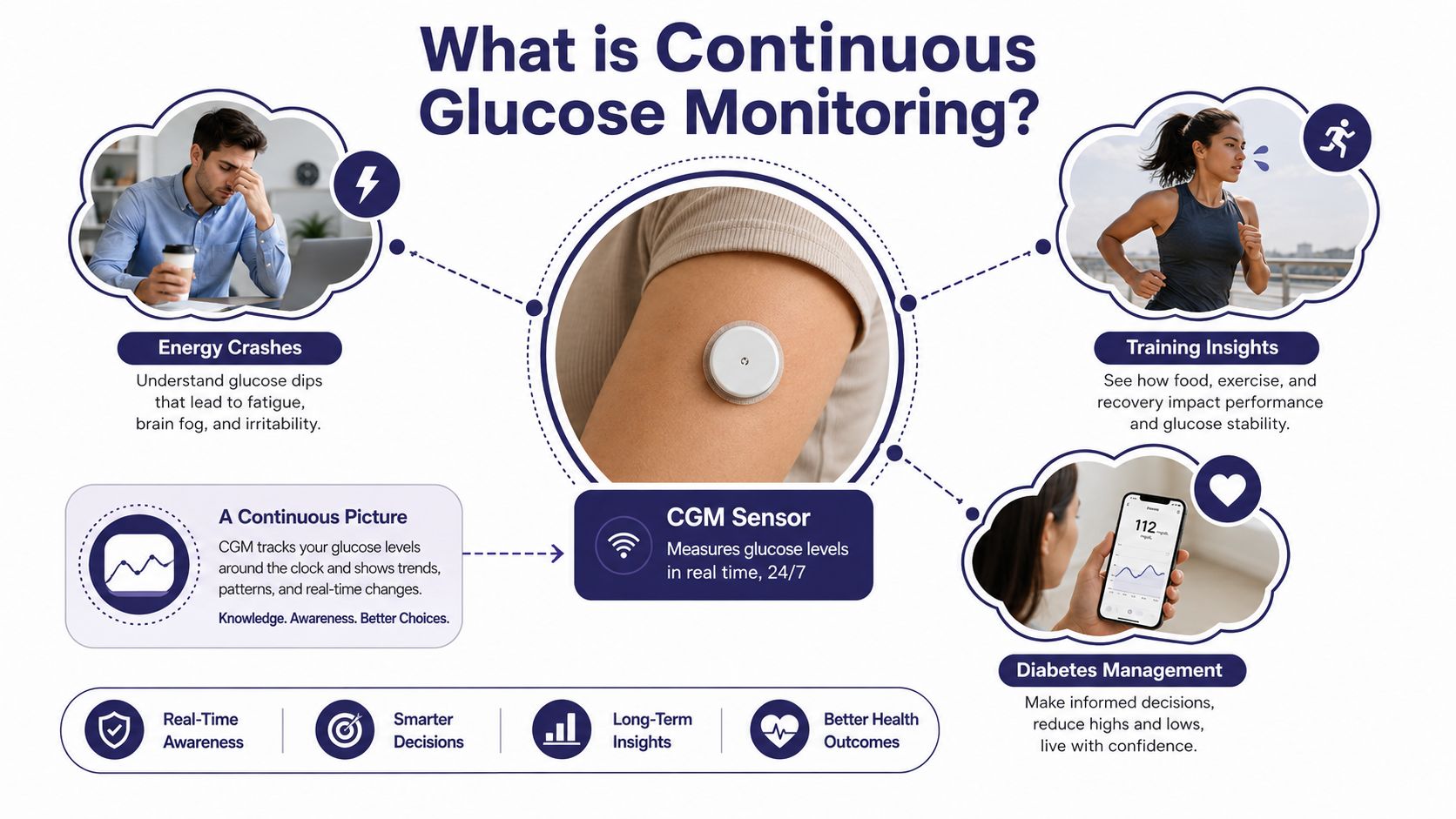
People sometimes mix up CGM and flash glucose monitoring because NHS language uses both. The practical difference is that flash systems traditionally needed you to scan the sensor to see the reading, while CGM is designed to stream readings continuously and can send alerts more actively. In real life, both are used to understand trends rather than isolated points.
Practical rule: if you want to know whether your glucose is rising, falling, or staying flat after a meal, CGM is far more informative than a single fingerprick.
If you want a broader overview of continuous monitoring concepts, the Guide to continuous heart monitoring gives a useful parallel in another area of wearable health tech.
For most readers, the key question is not whether CGM sounds clever. It is whether the data helps them make better decisions about food, movement, sleep, alcohol, or diabetes treatment. That is where the rest of the picture matters.
How a CGM Sensor Actually Works
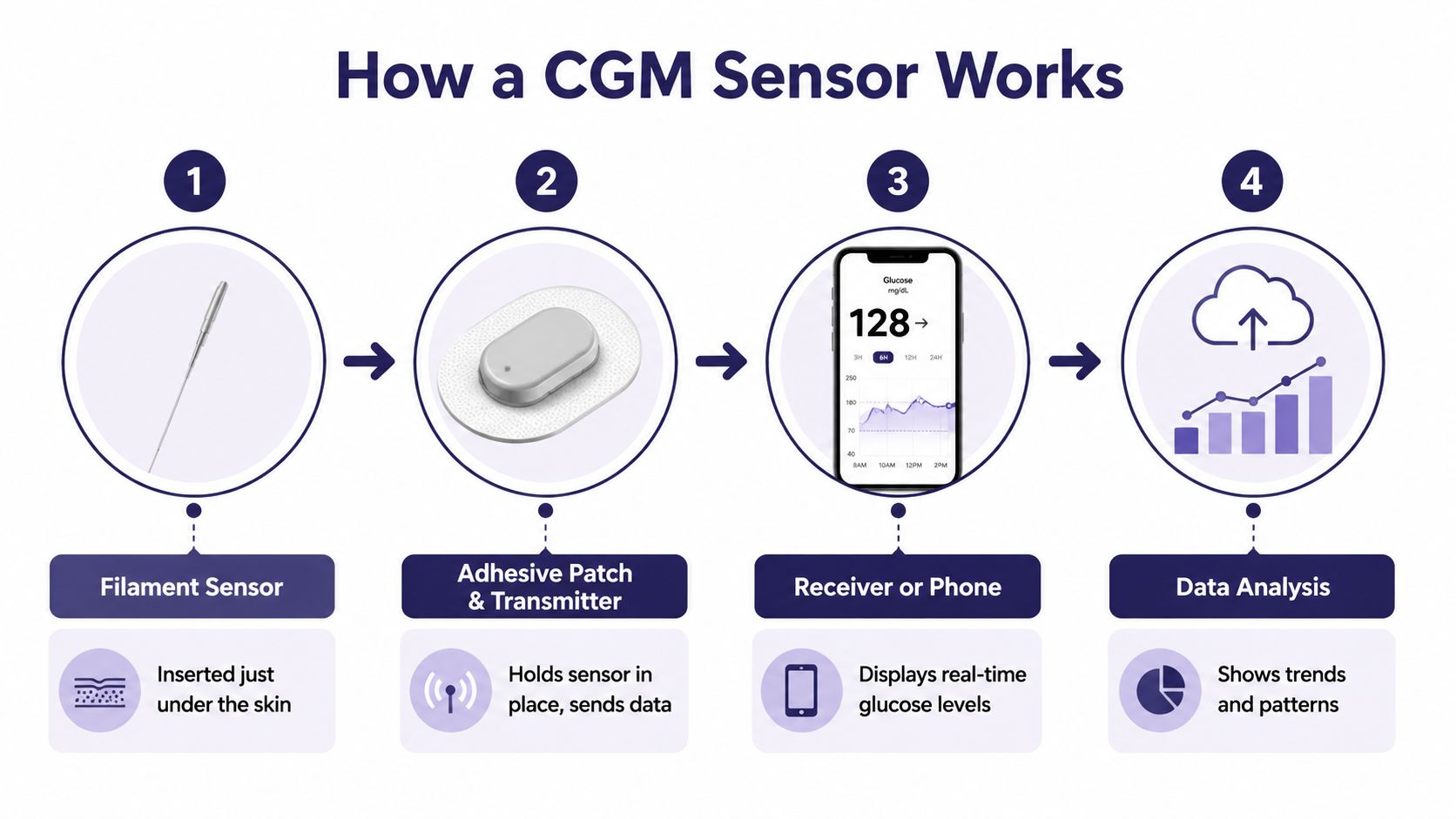
The hardware is simpler than many people expect. A CGM system usually has four parts, and each one does a different job. Once you understand the chain, the numbers on screen make much more sense.
From skin to screen
First comes the filament sensor, a fine sensor inserted just under the skin. It sits in the interstitial fluid, which is the thin fluid between your cells, not in the blood itself. That distinction matters because it explains why CGM is very good at showing trends, but not identical to a lab blood sample.
Second is the adhesive patch and transmitter. The patch keeps the sensor in place, while the transmitter sends the data onwards. Third is the receiver or phone app, where you see the actual glucose readings, trend arrows, alarms, and history. Fourth is the cloud platform, which stores and organises the data so a clinician can review patterns over time.
Why the readings can lag
CGM reads interstitial fluid, not blood, so it usually trails blood glucose by about 5 to 15 minutes. That lag is small enough to be useful, but large enough to matter if you are treating a hypo or making a fast decision after exercise. If you feel shaky, sweaty, confused, or “not right”, the fingerprick still has a role in confirming what is happening.
Wear time depends on the device, but many current systems last around 10 to 14 days before replacement. Most also have a warm-up period before the readings can be relied on, so it is not a magic patch you stick on and forget about.
If the number on the screen does not match how you feel, trust the symptoms first and confirm with a blood glucose test if you can.
That is the practical difference between CGM and a meter. A meter is a direct measurement at one moment. CGM is a time-series view that shows direction, duration, and the pattern around the reading. Used properly, it gives far more clinical context than finger-prick testing alone.
Types of CGM and Flash Monitors Available in the UK
The UK market is best thought of in three buckets. One is prescription monitoring for people with diagnosed diabetes. One is flash monitoring, which is especially familiar to people who use NHS pathways. The third is the newer wellness and sport-focused devices that sit outside mainstream diabetes care and have a narrower evidence base.
What most UK patients actually encounter
For people with type 1 diabetes, CGM or flash monitoring is now part of routine care pathways in England and across wider UK practice, shaped by NICE and NHS commissioning. For people with type 2 diabetes on insulin, access is also common when glucose checks are frequent or hypoglycaemia is a concern. Outside those groups, devices are often bought privately.
The evidence base is strongest when CGM is used for clinical diabetes management. For a healthy adult chasing optimisation, the benefits are much less certain. That does not mean the device is useless, only that the context matters.
| Category | Typical wear time | Calibration | App features | Indicative UK price |
|---|---|---|---|---|
| Prescription CGM for diabetes | Commonly 10 to 14 days | Some need little or no routine calibration, device dependent | Live readings, alerts, data sharing, trend arrows | Often NHS-funded for those who qualify |
| Flash glucose monitors | Commonly 14 days | Usually scan-based, calibration needs vary by device | Scanning, trends, history, some alerts on newer models | Often self-pay if not funded |
| Wellness or sport CGM | Commonly 10 to 14 days | Device dependent | App graphs, meal logging, some coaching features | Usually self-pay |
Choosing the right category
If you have diagnosed diabetes, the question is access and clinical fit. If you are an athlete or a data-driven professional, the question is whether you'll use the information well enough to justify the cost and the possible mental noise. If you are just curious, start by being honest about your goals.
A private or NHS conversation should centre on purpose, not hype. If your aim is better insulin safety, fewer lows, or clearer post-meal patterns, CGM is often sensible. If your aim is vague “health optimisation”, the case is weaker.
Accuracy and Key Limitations of CGM
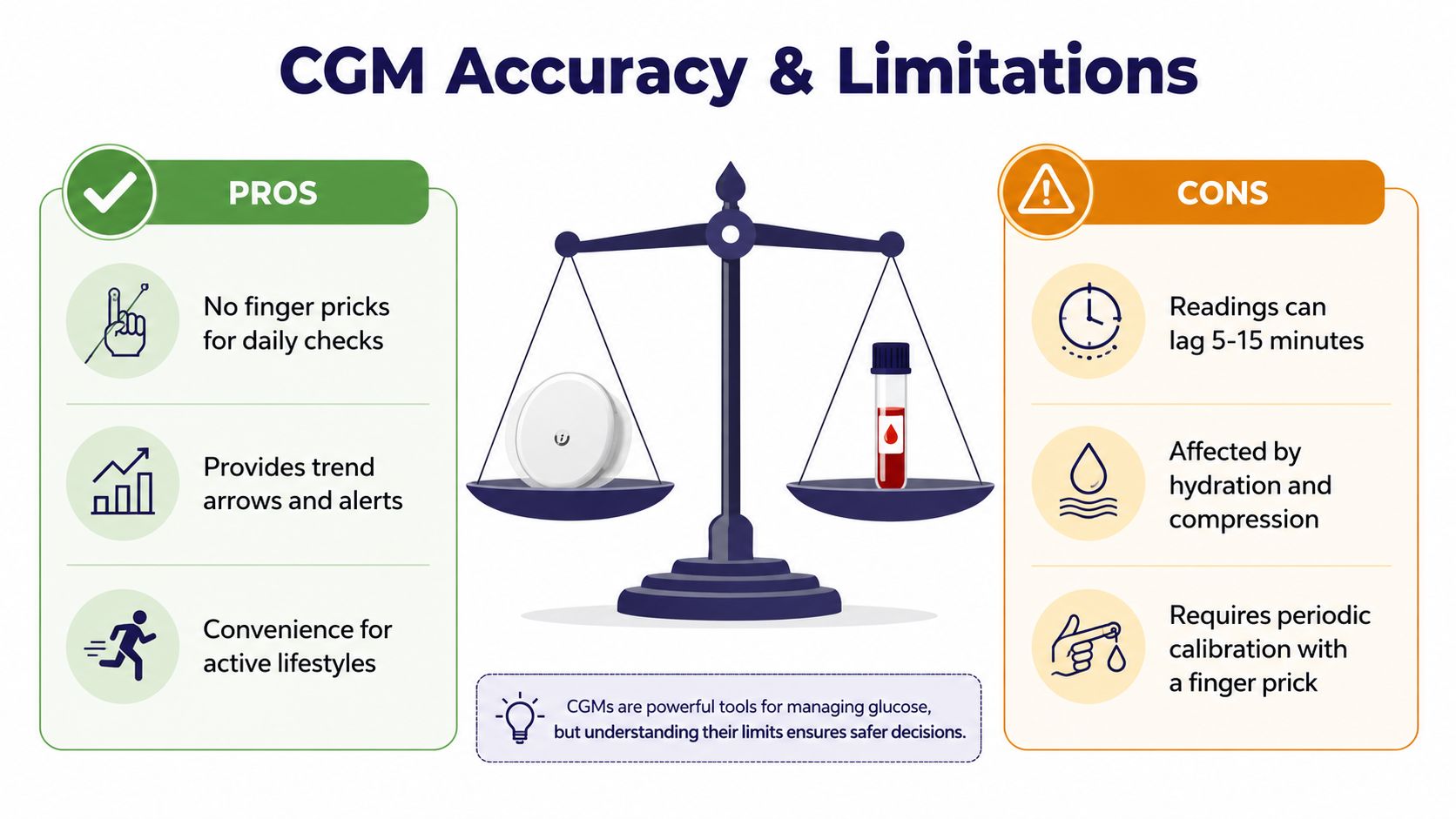
CGM is accurate enough to guide day-to-day decisions, but it is not perfect. In clinic, I explain it as a decision-support tool worn on the body, not a laboratory instrument. That distinction matters in UK practice, because NICE-aligned use is based on whether the device gives reliable information for the right patient, not on whether it replaces every fingerprick test in every situation.
What accuracy means in plain English
You will sometimes see accuracy discussed as MARD, which stands for mean absolute relative difference. In practical terms, the smaller the percentage, the closer the sensor tends to be to a reference blood test across many readings. You do not need to memorise the formula, only to understand that accuracy is judged over a pattern of readings, not by one reassuring result on a good day.
The limits users need to manage
The first limitation is the lag between blood glucose and interstitial fluid. That matters most when glucose is changing quickly, especially after treating a hypo or after intense exercise. The second is compression lows, which can happen if you sleep on the sensor and the reading drops artificially.
Hydration, rapid shifts in glucose, and ordinary day-to-day variation can also change how a trace looks. Some devices and some situations are more prone to confusing readings than others, and a fingerprick check still makes sense when the number and the symptoms do not match. People who take medications or substances that interfere with certain systems should ask their clinician about their specific device, because the answer depends on the monitor being used.
Useful habit: treat a CGM reading as a prompt to think, not an automatic instruction to act.
Overconfidence is the main trap. A graph can make a noisy day look more scientific than it is, but a few odd readings do not mean your body has suddenly changed. The people who get the most from CGM learn when to trust the trend and when to double-check the number.
For the right patient, those caveats are manageable. They do not make CGM unreliable. They make it a tool that needs judgment, the same way a home blood pressure monitor does. If you are weighing whether it suits your goals, a practical discussion with a clinician, or a review through remote health monitoring guidance, is more useful than assuming every graph is equally meaningful.
If you are comparing meal patterns alongside glucose balance, the supplement recommendations guide is one place readers often use for a broader diet and supplement perspective. It should sit alongside clinical advice, not replace it.
Using CGM Data to Drive Lifestyle Change
CGM becomes useful when it changes what you do next. Without that, it is just a colourful graph. With it, meals, movement, sleep, alcohol, and stress stop being vague lifestyle ideas and become visible, testable inputs.
Turn the graph into a short experiment
Start with one meal pattern you repeat often. Breakfast is usually the easiest place to begin, because many people can see the effect within a day or two. Try one version with more protein, fibre, and healthy fat, then compare it with a more refined or carbohydrate-heavy version. A walk after eating often shows up clearly too, especially if you do it consistently.
The same logic works with sleep and stress. Poor sleep can leave a very different pattern from a solid night. Stressful workdays, skipped meals, alcohol, and late training sessions all leave fingerprints in the trace, even when the number looks fine in the moment.
If you want a structured way to think about nutrient choices alongside glucose balance, the supplement recommendations guide is one place readers often go for a broader diet and supplement perspective. Use that kind of reading as background, not as a substitute for a proper assessment.
Sport, work, and weight management
For athletes, CGM can highlight fuel timing around training and recovery meals after it. For busy executives, it can explain the afternoon slump that happens after a large lunch and no movement. For people trying to lose weight, it can reinforce the kind of meals that are usually steadier, often built around protein, fibre, and fat rather than a quick carb hit.
That fits a lifestyle medicine approach well, because the aim is not to obsess over every spike. The aim is to learn which small changes make the day smoother.
- Try a 10-minute walk: Do it after one repeat meal and compare the trace with a day you sit still.
- Change breakfast composition: Swap a refined breakfast for one with more protein and fibre, then watch the post-meal shape.
- Adjust evening habits: Eat a bit earlier, reduce alcohol, or protect sleep, then check whether overnight patterns settle.
The important guardrail is mental health. Data can become anxiety if you stare at it constantly. Set a weekly review window, look for patterns, and make one change at a time.
The remote health monitoring overview is a useful reminder that digital health tools work best when they support proper clinical follow-up rather than replace it.
Who Should Consider CGM and How to Access It in the UK
A CGM makes most sense when there is a clear glucose problem to solve. In UK practice, that usually means diabetes care first, then selected people with other metabolic questions where short-term glucose patterns might change management. NICE guidance says adults with type 1 diabetes should be offered CGM or flash monitoring, and it also recommends CGM for adults with type 2 diabetes on insulin who would otherwise need eight or more finger-prick tests per day, or who have recurrent or impaired awareness of hypoglycaemia. Those are the patients most likely to benefit in a way that changes day-to-day care.
NHS route versus private route
On the NHS, access usually starts with a GP, diabetes nurse, or diabetes specialist team. Local commissioning and the patient's clinical history shape what is available, so access is not always the same from one area to another. That matters for equity, because uptake can vary by age, deprivation, ethnicity, and education level when provision is uneven.
Private access is more direct. You book a longer consultation, go through your history, medicines, goals, and concerns, then decide whether CGM is likely to help. If it does, you can be directed to suitable supply channels or prescription options where that is appropriate.
If you are also managing medications such as GLP-1 therapy, it helps to read a practical guide to using GLP-1 for diabetes so you can see how glucose monitoring and treatment choices fit together.
For people who are trying to understand whether symptoms or a borderline result need further testing, it can also help to learn about glucose tolerance testing before assuming a wearable monitor is the first step.
Who probably should not rush into it
Healthy people chasing optimisation without symptoms are usually not the best place to start. The evidence is thinner there, and the risk is that you collect data without changing anything meaningful. That can lead to frustration, unnecessary expense, and a lot of self-monitoring with very little return.
A good CGM conversation starts with a problem to solve, not a gadget to buy.
If you have repeated hypos, unexplained swings, insulin-treated diabetes, or you are trying to understand patterns that affect your safety and day-to-day control, CGM is worth discussing. If you just want to see what a croissant does to your graph, the answer is probably less urgent.
Reading CGM Data Time in Range and Daily Patterns
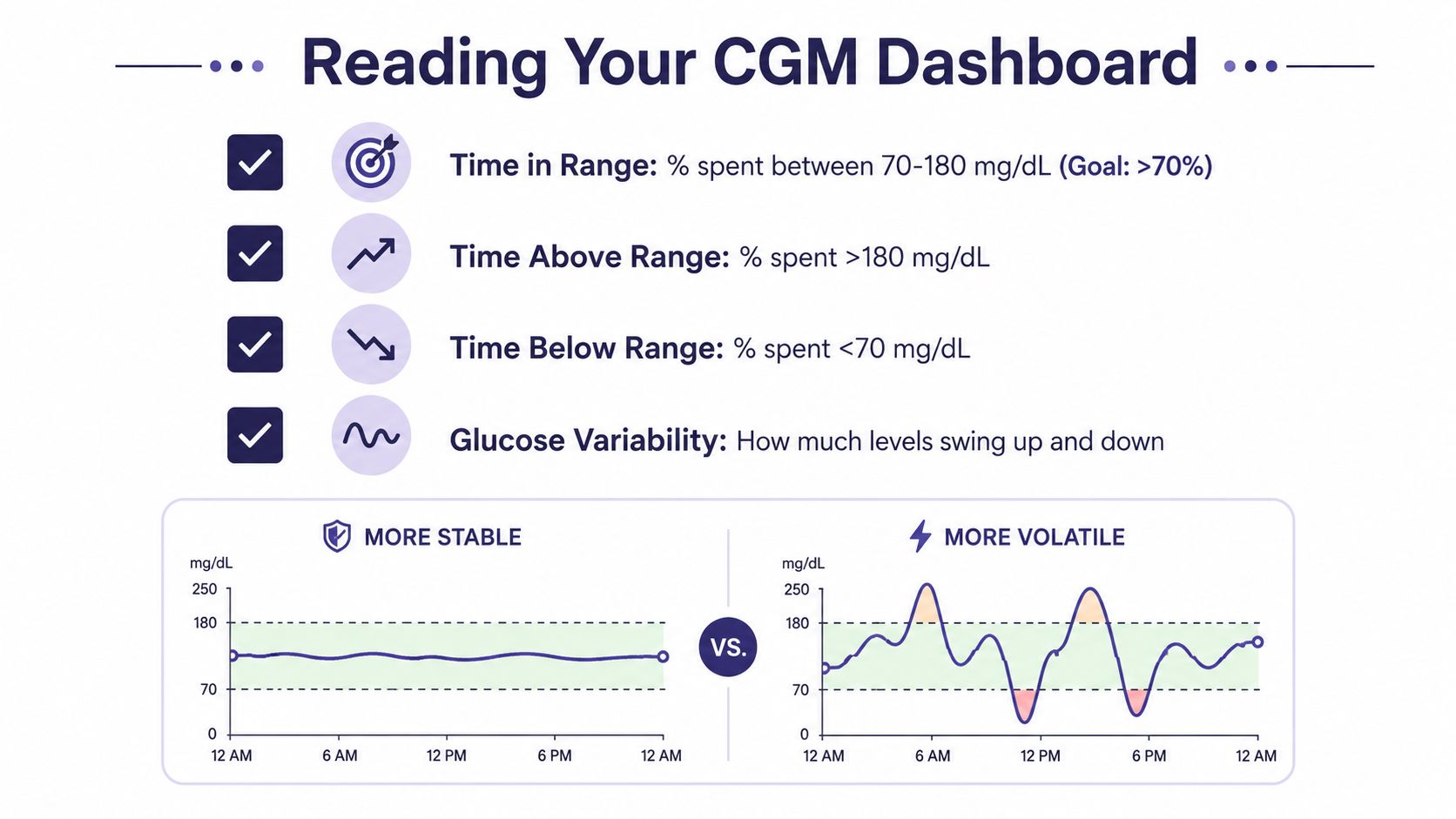
The screen can look intimidating at first, but the core metrics are straightforward. Most clinics focus on the 70 to 180 mg/dL range for many adults, because that is the practical band where control is usually judged. The point is not perfection. It is pattern recognition.
The numbers that matter first
Time in range tells you how much of the day sits inside the target band. Time above range shows how often you run high, and time below range shows how often you go low. Glucose variability describes how much the readings swing up and down, while the ambulatory glucose profile, or AGP, is the 24-hour report many clinics review.
NICE-linked targets used with CGM include time below range under 4% for many individuals and under 1% for significant hypoglycaemia, while time above 180 mg/dL should generally be under 25% NICE-linked CGM targets. Those figures are useful because they turn a fuzzy “better control” conversation into something concrete.
What to look at first
Start with the pattern that appears most often. Post-meal spikes usually point to meal composition or timing. Overnight dips may suggest too much medication, late exercise, alcohol, or an evening routine that needs tightening. A dawn rise in the morning often points to the body's early-morning hormone pattern, which is something a clinician can help interpret.
Bring specific questions to review:
- Which meal pattern spikes me most: breakfast, lunch, or dinner?
- **Do lows happen overnight, after exercise, or after medication?
- **What changed on the days the trace looked smoother?
- **Should I make one lifestyle change first, or adjust treatment as well?
If a reading, symptom, and trend do not line up, that is the moment to call a clinician rather than self-experiment indefinitely. CGM works best when it leads to a sensible action, not endless analysis.
Costs Access and Getting Started Through a Private GP
A lot of people in Bristol ask the same practical question after the clinical one. They want to know whether CGM is something they can realistically pay for, and whether it will become another subscription they abandon after two weeks. That concern is fair.
What the first appointment usually looks like
A sensible private GP consultation is not a hard sell. It is a 30 to 60 minute review of your medical history, medicines, symptoms, and goals, followed by a shared decision on whether CGM fits. If it does, you get a plan for prescription, supply, and follow-up. If it does not, you should leave with a clearer non-device plan.
NHS funding remains the route for many people who meet criteria, but self-pay is common when someone wants quicker access or falls outside NHS eligibility. Pharmacy and supplier pricing vary, so any budget should be treated as a working estimate rather than a fixed quote.
A realistic mindset before you start
CGM is a tool, not a verdict. If you use it well, it can support better nutrition, better movement timing, better sleep habits, and calmer decision-making around diabetes treatment. If you use it badly, it can make every meal feel like a test.
The best first step is simple:
- Clarify the reason: diabetes safety, better pattern recognition, or sport and lifestyle insight.
- Choose the route: NHS if you qualify, private if you want a broader assessment or faster access.
- Plan the follow-up: review the data after a short trial, then decide whether it earned its keep.
If you'd like a calm, clinically grounded conversation about whether CGM makes sense for you, The Lagom Clinic offers longer private GP appointments in Bristol, practical lifestyle advice, and support that looks at the whole picture rather than one graph. Visit The Lagom Clinic to book a consultation and talk through the right next step for your health.

 Members Consultation