


Often, individuals drawn to wellbeing coaching aren't in crisis. They're functioning, turning up to work, keeping family life moving, replying to messages, meeting deadlines. But they also know something is off. Sleep is lighter than it used to be. Exercise happens in bursts, then disappears. Food becomes whatever fits between meetings. Stress sits in the background all day, then shows up as irritability, headaches, poor concentration, or a sense that life has narrowed into pure maintenance.
That state matters because health isn't only the absence of disease. In practice, many people want something more ambitious. They want steadier energy, a clearer head, better resilience, fewer stress-related setbacks, and habits that hold up when life gets busy.
That's where wellbeing coaching can be useful. Not as a rescue tool for every problem, and not as a substitute for medical or psychological treatment, but as a structured partnership that helps you translate good intentions into daily action. For readers whose main issue is work strain and depletion, resources such as Baz Porter's burnout program can also help you understand how burnout support is approached outside a medical setting.
From Surviving to Thriving An Introduction
A common pattern looks like this. You know what would help. Go to bed earlier, move more often, eat more deliberately, drink less, stop checking emails late at night, take a proper lunch break. None of those ideas are mysterious. The difficulty is doing them consistently when your schedule, stress level, and responsibilities keep changing.
Wellbeing coaching works best in that gap between knowledge and follow-through. It gives structure to change. Instead of trying to overhaul your life in one determined weekend, you work on the specific behaviours that are most likely to improve how you feel and function.
What thriving usually means in real life
For most adults, thriving isn't a dramatic transformation. It's more practical than that.
- More stable energy: You don't rely on caffeine and adrenaline to get through the afternoon.
- Better recovery: Sleep, downtime, and exercise support you instead of becoming another task list.
- Improved self-awareness: You notice your triggers before they become patterns.
- Clearer priorities: Health decisions become easier because they connect to values, not guilt.
Wellbeing coaching is often most helpful when someone is capable and motivated, but stuck in a cycle of inconsistency.
A good coach helps you ask better questions. Why does exercise keep dropping out on Thursdays? Why does snacking escalate after poor sleep? Why does stress lead to late-night work rather than proper rest? Those aren't failures of discipline alone. They're patterns, and patterns can be understood and changed.
What doesn't work
Some approaches sound appealing but rarely last.
- Generic wellness advice: Broad tips with no link to your routine, health status, or constraints.
- All-or-nothing planning: Extreme goals that collapse the first time a week gets difficult.
- Moralising: Framing behaviour as good or bad instead of understanding what drives it.
- Confusing coaching with treatment: Using coaching where a medical or mental health assessment is needed.
The strongest results usually come from a calmer, more realistic approach. Start where you are. Choose a few meaningful targets. Review them properly. Adjust without self-criticism.
What Is Wellbeing Coaching Exactly
Wellbeing coaching helps a person turn good intentions into repeatable habits that hold up in real life. In clinic, that often means someone arrives saying they know what they should be doing, but sleep is erratic, stress is driving food choices, exercise keeps slipping, and every plan falls apart by Thursday.
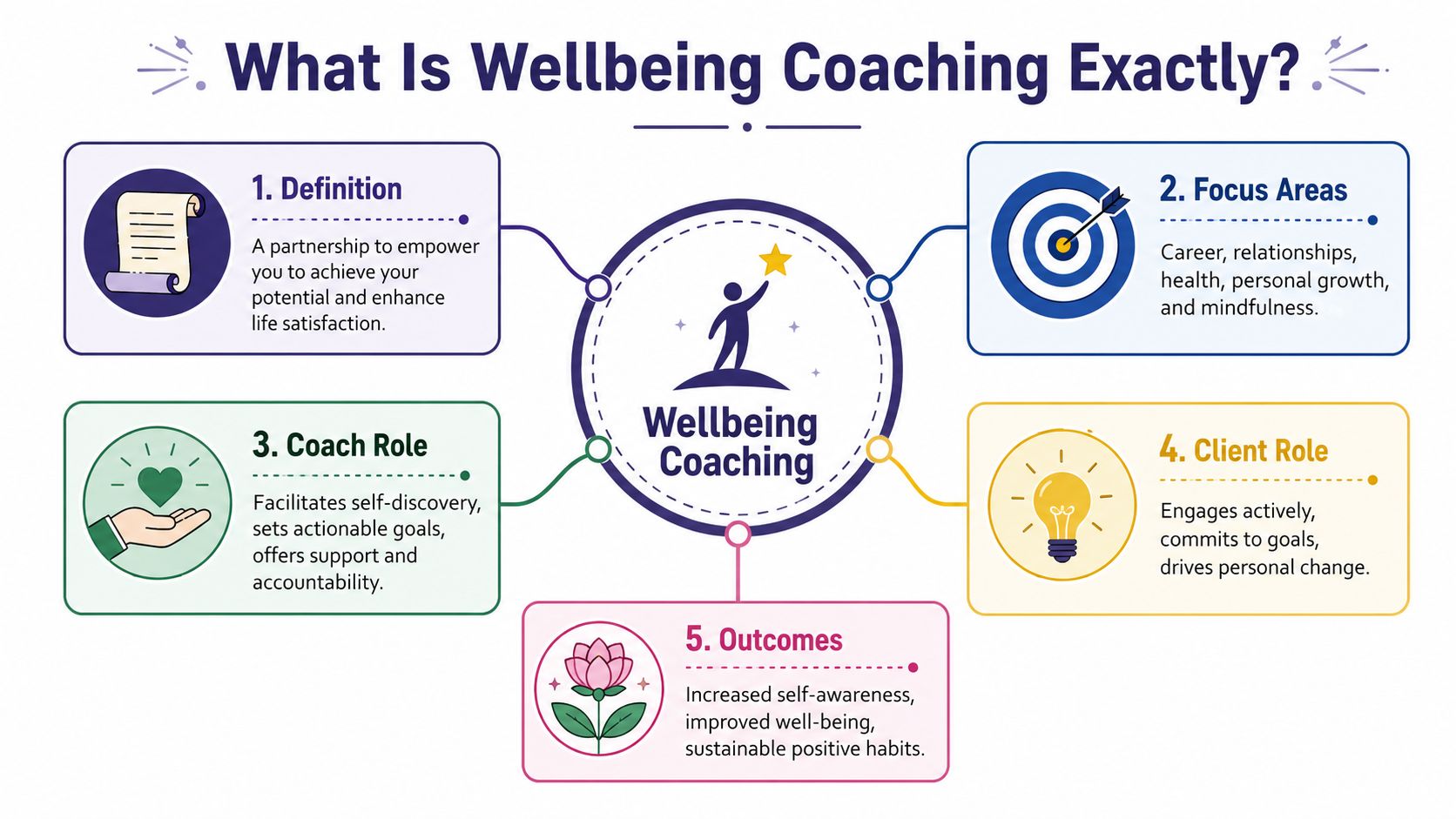
A good coaching process is structured, client-led, and practical. It focuses on behaviour change, self-awareness, and follow-through across areas such as sleep, stress, movement, nutrition, recovery, and daily routines. The aim is not to hand out generic advice. It is to help you understand what is getting in the way, choose realistic actions, and review what works.
In a medically-integrated setting, coaching also sits in the right place. It does not diagnose illness or replace treatment. It works best alongside clinical care, especially where fatigue, burnout, weight change, poor sleep, digestive symptoms, low mood, or hormone concerns may have an underlying medical component. That is one reason coaching inside a GP-led clinic is often safer than standalone coaching. Symptoms can be assessed properly, red flags are less likely to be missed, and the plan can be adjusted around real health needs rather than assumptions.
The role of the coach
A capable wellbeing coach listens for patterns and translates them into a plan you can carry out on an ordinary week, not an ideal one. That may involve refining a sleep routine, identifying stress triggers, building better work boundaries, or using tools such as nutrition plans to improve gut health where food choices are part of the picture.
The work usually comes back to four questions:
- What needs to change first? The priority should be clear enough to act on.
- What keeps disrupting it? Timing, stress, pain, childcare, work demands, low mood, and poor sleep all matter.
- What is realistic this week? Small, repeatable actions beat ambitious plans that collapse.
- What did the trial show? Coaching uses review, not self-criticism.
Practical rule: If a plan depends on perfect motivation, it is poorly designed.
The scope of wellbeing coaching
Wellbeing coaching often covers overlapping areas of daily health rather than one isolated goal. Someone may come in wanting to improve energy, then realise the underlying drivers are late working, fragmented sleep, missed meals, and no recovery time. Coaching brings those links into view and helps build a plan around them.
| Area | What coaching may focus on |
|---|---|
| Physical wellbeing | Activity habits, pacing, recovery, daily movement |
| Mental wellbeing | Stress management, resilience, burnout risk, coping routines |
| Lifestyle routines | Sleep timing, work boundaries, planning, habit design |
| Personal effectiveness | Motivation, consistency, priorities, self-monitoring |
For many people, mental wellbeing is part of this work but not the whole of it. Coaching can support behaviour change around stress and coping, while a separate clinical assessment may still be needed if symptoms suggest anxiety, depression, trauma, or another condition. For a practical example of how daily habits affect mood and resilience, see our guide on how to improve mental wellbeing.
What wellbeing coaching is trying to build
The end point is self-management. You should need less external prompting over time, not more. Good coaching helps you spot patterns earlier, respond with more skill, and make steadier decisions under pressure.
That is also where medically-integrated coaching has an advantage. Progress is not judged by willpower alone. If poor concentration turns out to be sleep apnoea, if low energy reflects iron deficiency, or if stress is masking depression, the next step can include medical care as well as coaching. That joined-up approach is more grounded, and in practice it often leads to better decisions.
The Science-Backed Benefits of Wellbeing Coaching
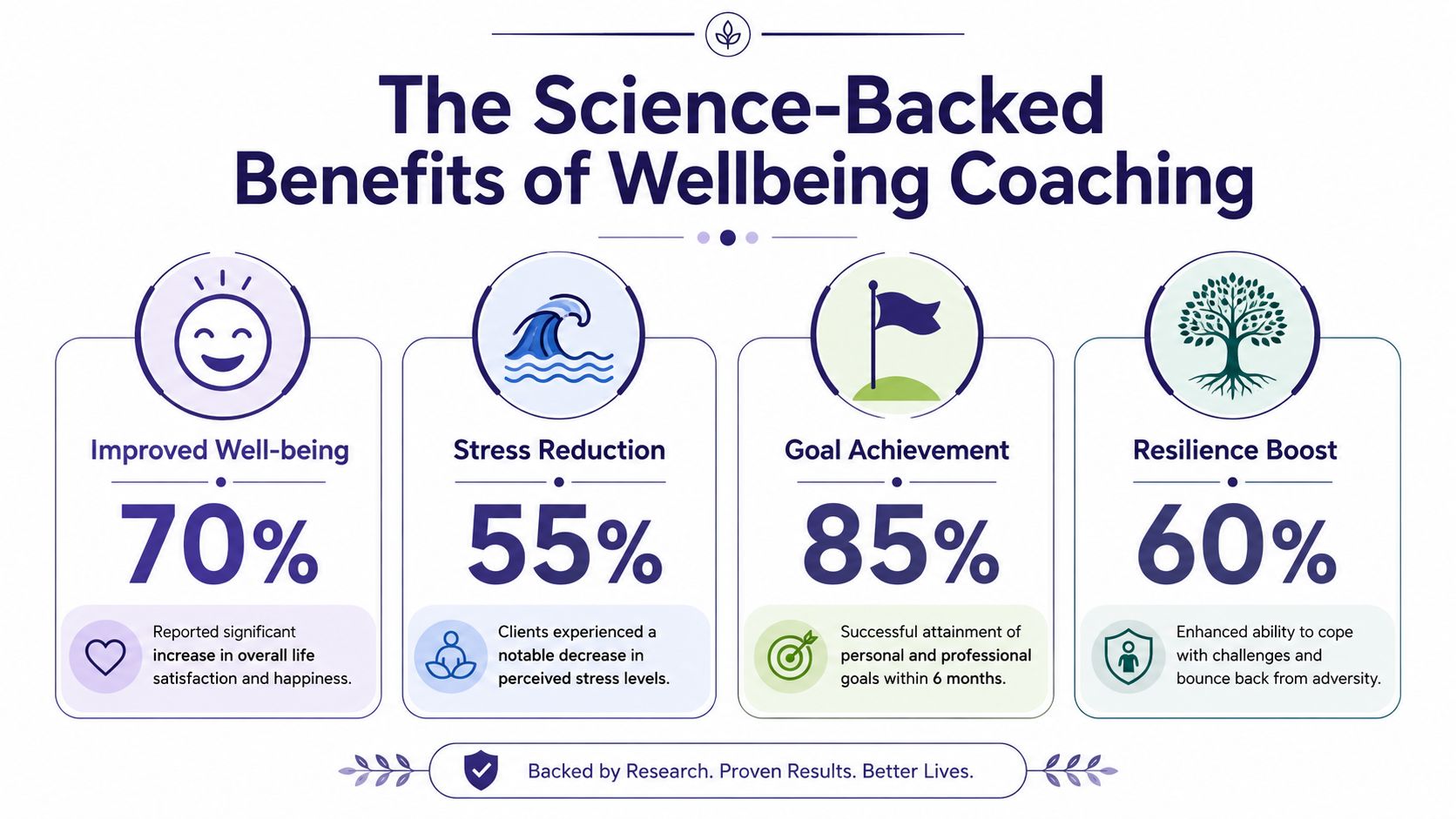
Wellbeing coaching deserves to be judged by outcomes, not branding. The most useful evidence asks a practical question. Do people maintain meaningful improvements once the early enthusiasm wears off?
A landmark review of 28 health and wellness coaching studies found that 25 studies, or 89.3%, showed partially or fully sustained or improved outcomes at follow-up periods of at least 24 weeks. That finding covered physiological, behavioural, and psychological variables, which makes it far more relevant than a vague claim that coaching helps people “feel better”.
Why those results matter clinically
In day-to-day health work, short bursts of motivation are common. Maintenance is the hard part. Someone can manage a better week of sleep, a fortnight of exercise, or a month of improved food choices. The true test is what remains in place months later.
That's why sustained follow-up matters. It suggests coaching may help people build habits that survive normal life pressures.
A second reason this matters is workload and stress. The UK continues to face a substantial burden from workplace strain. The HSE reports that work-related stress, depression or anxiety accounted for 16.4 million lost working days in 2023/24, which is noted in this discussion of wellbeing coaching for stress and resilience support. For many busy adults, the issue isn't lack of information. It's lack of a workable system.
What benefits tend to be most realistic
The strongest benefits are usually practical and cumulative rather than dramatic.
- Better consistency: Smaller actions repeated with review tend to outperform ambitious resets.
- More accurate self-observation: People begin to identify what disrupts them, whether that's meetings, poor sleep, pain, alcohol, or emotional overload.
- Improved follow-through: Accountability helps convert intention into behaviour.
- Stronger mental wellbeing support: If this is your focus, our guide on how to improve mental wellbeing is a useful companion to coaching.
Nutrition often plays a role here as well, especially when energy, digestion, sleep, and mood all interact. If someone needs practical ideas rather than abstract advice, structured nutrition plans to improve gut health can be a helpful starting point alongside broader behaviour work.
Where the field is expanding
There's also a clear market signal around mental wellbeing support. The UK mental wellbeing coaching sub-sector generated USD 2,239.4 million in 2024 and is projected to reach USD 4,867.1 million by 2030, growing at a 14% CAGR. That projection suggests demand is rising fastest in areas linked to stress, emotional resilience, and sustainable coping.
That doesn't prove coaching is right for everyone. It does support what many clinicians already see. People increasingly want structured, non-clinical support before stress turns into something more entrenched.
Wellbeing Coaching vs Therapy Understanding the Difference
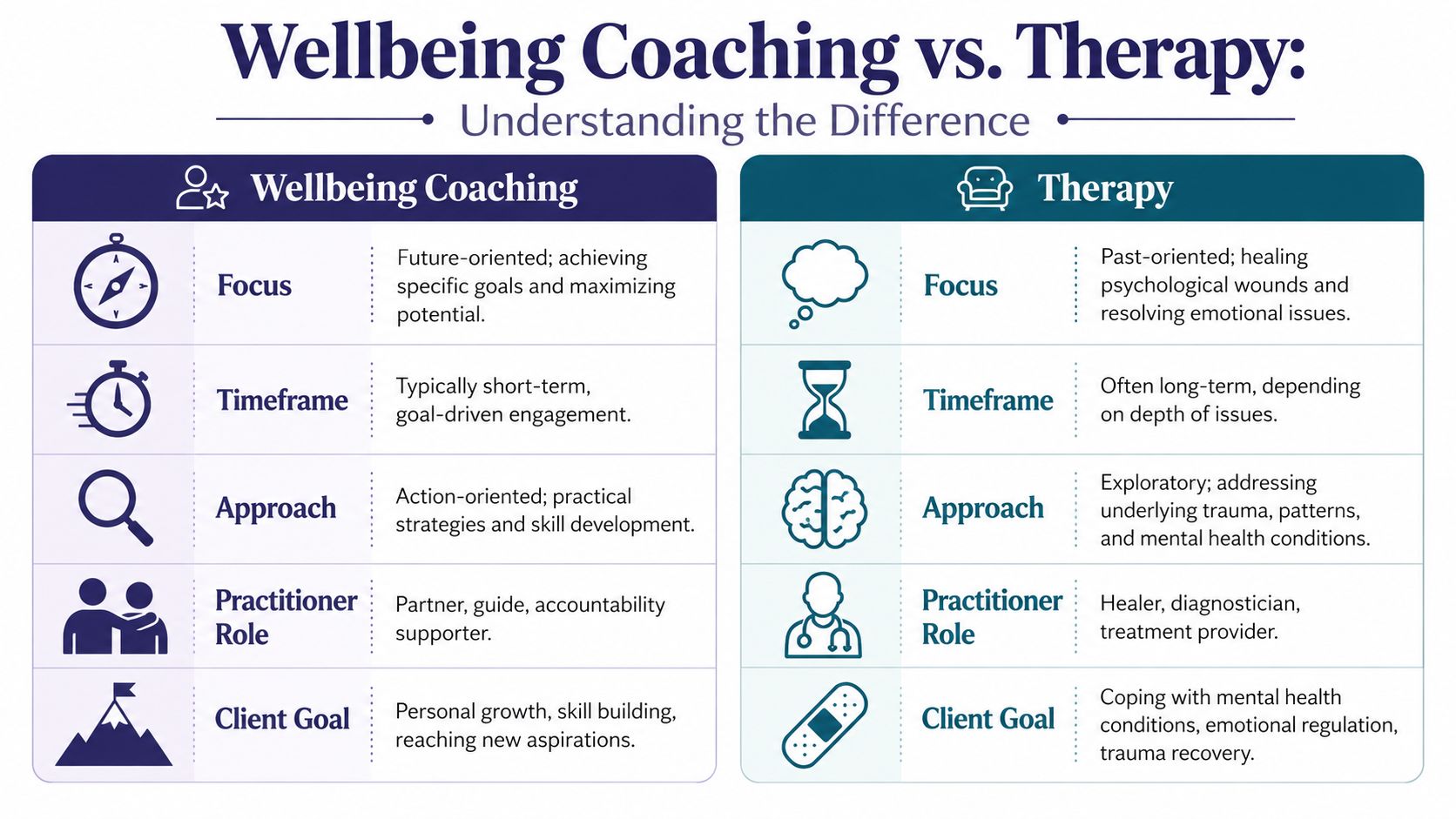
This is the point many people need clarified most. Wellbeing coaching is not therapy. Both can be valuable. They do different jobs.
Therapy treats psychological distress, mental health conditions, trauma, and patterns that require clinical exploration or treatment. Coaching focuses on goals, habits, motivation, accountability, and future-oriented behaviour change in people who are generally able to function but want better structure and support.
Wellbeing coaching vs therapy at a glance
| Focus Area | Wellbeing Coaching | Therapy (Psychotherapy) |
|---|---|---|
| Main focus | Future goals, habits, routines, self-management | Emotional healing, mental health symptoms, psychological patterns |
| Typical starting point | “I'm functioning, but I'm stuck” | “I'm struggling and need treatment or deeper support” |
| Style | Action-oriented, structured, behaviour-focused | Exploratory, therapeutic, clinically informed |
| Practitioner role | Guide, partner, accountability support | Clinician or therapist providing treatment |
| Best for | Stress management, burnout prevention, lifestyle change, resilience | Anxiety disorders, depression, trauma, grief, significant distress |
When coaching is a good fit
Coaching can be very useful if you're dealing with pressure, fatigue, inconsistency, or low-level burnout while still managing the basics of work and home life. It's especially relevant when the question is, “How do I stop living reactively?”
Examples include:
- Stress with intact function: You're coping, but at a cost.
- Repeated lifestyle drift: You start well, then lose momentum.
- Burnout prevention: You want to act before exhaustion becomes entrenched.
- Health behaviour change: You need accountability and a realistic framework.
When therapy or medical care should come first
Coaching is not enough if someone has significant depressive symptoms, intrusive anxiety, trauma-related symptoms, disordered eating, substance dependence, or any concern about self-harm. Those need proper assessment and, where appropriate, treatment.
If symptoms are persistent, severe, or affecting safety, work, sleep, appetite, or relationships in a major way, start with clinical care.
For many people, the best answer is both, used appropriately. Therapy may address the deeper psychological load. Coaching may then help with implementation, routine, and recovery habits. If you're unsure where you sit, a clinician can help you make that call. For readers considering a more formal route into support, this overview of a mental health care plan explains how clinical guidance fits in.
The medically important distinction
This boundary isn't semantic. It protects patients. In a country where work-related stress, depression, or anxiety led to 16.4 million lost working days in 2023/24, coaching has a role in non-clinical resilience and burnout support. But diagnosed mental health disorders need treatment pathways, not motivational conversations dressed up as care.
A trustworthy coach knows where their scope ends.
Your Wellbeing Coaching Journey Explained
A good coaching process should feel clear from the first appointment. You should know what you are working on, how progress will be reviewed, and where coaching stops and medical care begins.
In a medically integrated clinic, that matters more. Fatigue, poor sleep, weight change, low mood, palpitations, gut symptoms, and repeated burnout can all look like lifestyle problems at first. Sometimes they are. Sometimes they point to thyroid disease, perimenopause, iron deficiency, sleep apnoea, anxiety, depression, or medication side effects. In my view, coaching is safer and more useful when those possibilities can be considered properly rather than guessed at.
How the process usually starts
The first conversation should establish your priority, your motivation, and the main barriers in the way. It should also cover the practical context. Work pattern, family load, sleep, energy, pain, medication, previous attempts at change, and what has made follow-through difficult before.
At The Lagom Clinic, this early stage can sit within a wider health picture. If someone says they want help with energy, stress, and consistency, a medically led team can ask the extra questions that standalone coaching may miss. That does not turn coaching into treatment. It means the plan is built on a safer foundation.
Early goals are usually modest on purpose. A useful target might be a 15-minute walk after lunch on three workdays, a fixed bedtime routine on Sundays to Thursdays, or preparing two simple lunches before a busy clinic or office week. Specific beats ambitious.
What happens in ongoing sessions
Ongoing sessions should follow a repeatable structure. Review what happened. Examine what got in the way. Adjust the plan. Agree the next action.
That rhythm sounds simple because it is. The skill lies in making each step honest and workable.
A good coach will ask for real observations rather than good intentions. What happened to sleep on the nights you worked late? What did pain do to activity? Which meetings knocked lunchtime off course? Which habit was too inconvenient to survive a stressful week? Those details are where change becomes realistic.
A useful review often follows four steps:
- Check the facts. What happened since the last session.
- Identify the barrier. Time pressure, symptoms, motivation, perfectionism, environment, or competing demands.
- Adjust the goal. Make it small enough to do consistently.
- Keep the follow-up. Repetition turns a plan into a routine.
Progress should be trackable. That might mean sleep timing, step count, meal preparation, stress scores, symptom patterns, or the number of days a habit was completed. In a medical setting, those patterns can also help flag when coaching alone is no longer the right tool.
Techniques that tend to work well
Good coaches use established behaviour change methods, even if they explain them in plain English rather than technical language.
- Motivational interviewing: Helps clarify why change matters to you, not just what you think you should do.
- Reflective questioning: Useful when you feel stuck, conflicted, or inconsistent.
- Shared goal-setting: Builds targets that fit real life, not an ideal week that never arrives.
- Regular review: Weekly or fortnightly sessions keep progress visible.
- Accountability support: Consistent follow-through without blame.
If follow-through is your sticking point, broader models of accountability coaching can be worth exploring, particularly when work habits, stress, and personal routines affect each other.
What usually gets in the way
Coaching tends to stall for predictable reasons. The goal is too vague. The plan is too large. The person is trying to force change on top of untreated symptoms. Or sessions become thoughtful conversations with no real test between one week and the next.
Watch for these signs:
- The target is hard to measure
- There is no review rhythm
- Barriers are discussed vaguely, not specifically
- The plan depends on willpower alone
- Symptoms that need clinical assessment are being folded into coaching
The best sessions often end with one or two clear actions and a realistic way to review them. That may sound simple. In practice, it is often the difference between another abandoned plan and steady progress that lasts.
How to Choose a Qualified Wellbeing Coach
Choosing a wellbeing coach requires more scrutiny than many people realise. The field includes thoughtful, well-trained practitioners, but it also includes people who offer confidence and enthusiasm without much method. That's risky if you have stress-related symptoms, a complex medical history, or significant barriers to change.
One important standard is context. Research on coaching for underserved groups argues that effective coaching must address social determinants of health and build trust, going beyond generic goals, as discussed in this research on coaching for underserved populations. In plain terms, your coach should understand that housing pressure, cost of food, shift work, caregiving, pain, and job insecurity all shape behaviour.
Questions worth asking before you commit
A good introductory conversation should leave you with a clearer sense of how the coach thinks, not just how they market themselves.
- What training have you completed? Look for formal coaching education and a clear explanation of their methods.
- How do you set goals and review progress? You want specifics, not vague talk about transformation.
- What kinds of clients do you work with most often? Relevance matters.
- How do you handle issues outside your scope? A serious coach should be comfortable referring on.
- How do you adapt for real-life constraints? Cost, time, family demands, pain, and work pressure should be part of the plan.
Signs of a stronger fit
Chemistry matters, but compatibility isn't enough on its own. Look for evidence of sound judgement.
| What to look for | Why it matters |
|---|---|
| Clear boundaries | Reduces the risk of coaching being used where treatment is needed |
| Structured process | Makes progress more likely and easier to review |
| Respect for context | Prevents unrealistic or tone-deaf advice |
| Collaborative style | Supports ownership rather than dependence |
A coach should make change feel more manageable, not make you feel inadequate for having a normal human life.
Red flags to take seriously
Be cautious if a coach promises sweeping change, dismisses medical issues, or treats every setback as a mindset failure. Health behaviour is influenced by physiology, workload, sleep, relationships, pain, finances, and environment. Any model that ignores that is too blunt to be useful.
A good coach doesn't need to know everything. They do need to know the limits of what coaching can do.
Start Your Journey at The Lagom Clinic in Bristol
A medically integrated model changes the quality of wellbeing coaching. It adds context, safety, and better decision-making. That matters most when someone's symptoms might have more than one cause.

In a clinic setting, coaching doesn't have to rely only on motivation or impression. The most effective workflows are data-in-the-loop. Research on health coaching found that objective data such as step counts were rarely self-explanatory and became useful when coach and client interpreted them together through discussion, context, and behavioural hypotheses, as described in this study on using personal health data in coaching conversations.
Why medical integration improves coaching
That point is more important than it may sound. Low activity could reflect overwork, but it could also reflect pain, poor sleep, low mood, illness, or recovery issues. Repeated fatigue might be a routine problem, or it might justify medical assessment. Weight change, poor concentration, or disrupted sleep can sit at the boundary between lifestyle strain and clinical concern.
A GP-led environment is better placed to separate those possibilities.
- Clinical oversight: Symptoms can be reviewed properly rather than being framed only as habit problems.
- Objective inputs: Health screening, blood tests, ECGs, or wearable data can inform the conversation where appropriate.
- Joined-up care: Coaching can support lifestyle change while medical issues are assessed or treated.
- Safer boundaries: Patients are less likely to be left in the gap between “not ill enough” and “not coping well”.
What this means for the patient
The value isn't just convenience. It's precision. Instead of generic advice to “move more” or “stress less”, the plan can be shaped around what your body, schedule, symptoms, and goals are showing.
That tends to produce better questions. Is the issue poor recovery, not poor discipline? Is late-night eating being driven by under-fuelling earlier in the day? Is low motivation really sleep debt? Once those patterns are visible, coaching becomes much more effective.
For people with underlying health concerns, that medically integrated approach is often the difference between supportive coaching and guesswork.
If you want support that combines proactive lifestyle medicine with proper clinical oversight, The Lagom Clinic offers a Bristol-based, GP-led approach to wellbeing that looks at the whole picture. That means time to understand your symptoms, habits, goals, and health data, then turning that information into a practical plan you can follow.


 Members Consultation