


You've got a symptom that won't quite settle. It might be a shoulder that keeps catching when you train, bloating and upper abdominal discomfort that doesn't fit your usual pattern, or pelvic pain that's become too frequent to ignore. You want an answer, not a vague promise that someone will look into it later.
That's where a private ultrasound scan can be useful. The value isn't merely speed. It's whether the scan gives information that changes what you do next, whether that means reassurance based on a proper assessment, a treatment plan, physiotherapy, medication review, or a referral into the right specialist pathway.
As a private GP, I think that's the right way to judge any test. A scan should help you make a better medical decision. If it doesn't, it risks becoming expensive reassurance.
Understanding Private Ultrasound Scans and Their Uses
A patient might come in with right upper abdominal pain after meals, a new lump in the neck, or pelvic symptoms that have started to affect daily life. In those situations, ultrasound is often the most sensible first test because it can show structure, fluid, and blood flow in real time without exposing you to radiation.
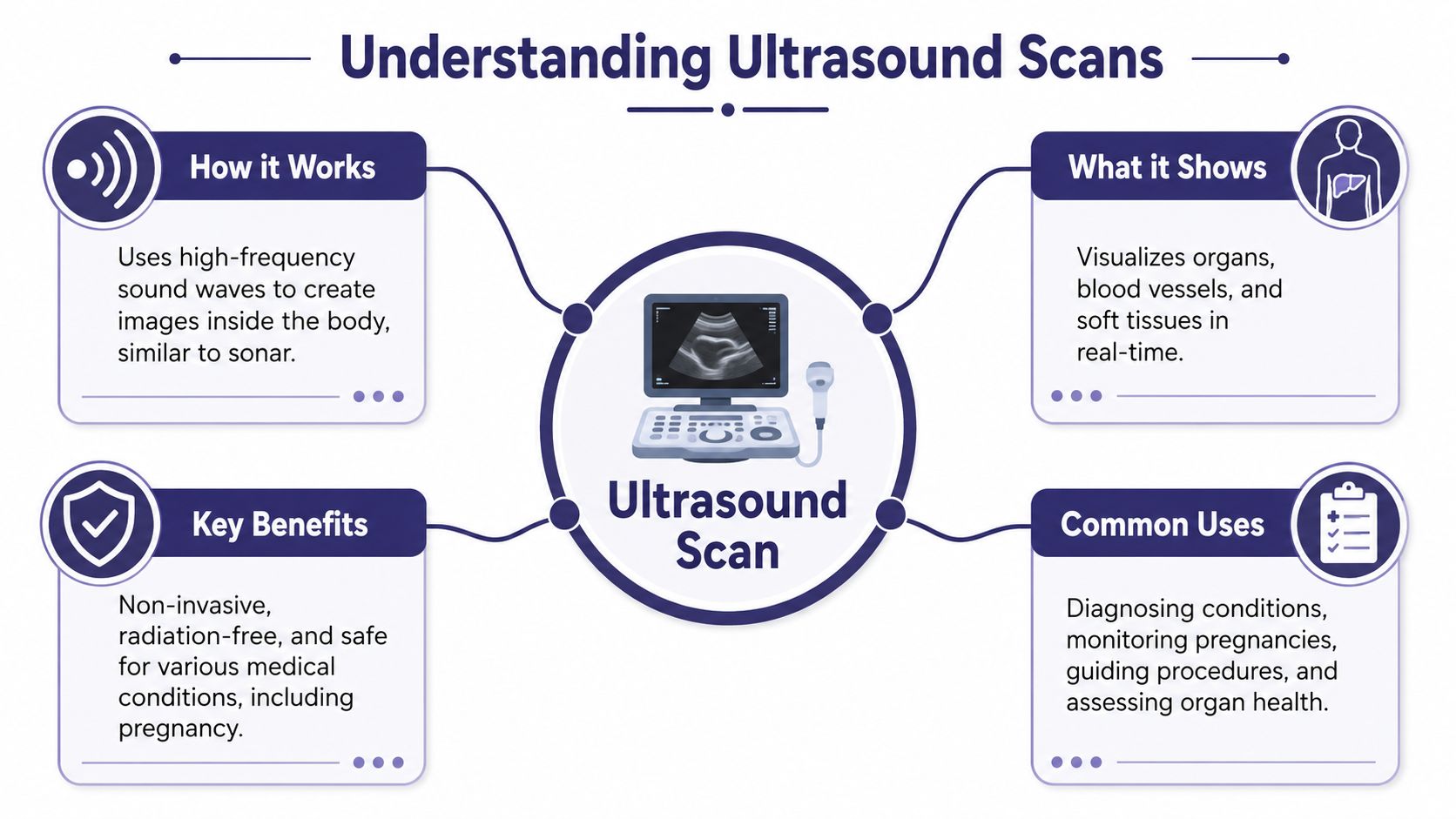
An ultrasound scan uses high-frequency sound waves to build live images from inside the body. What it can show depends on the area being examined, the probe used, and the skill of the clinician performing and interpreting the scan. Lower-frequency probes are better for deeper structures such as the liver or kidneys. Higher-frequency probes give finer detail for superficial problems such as tendon injuries or small lumps under the skin.
When ultrasound is clinically useful
Used properly, ultrasound helps answer a specific medical question. Common reasons include:
- Abdominal symptoms such as ongoing pain, bloating, or suspicion of gallbladder, liver, kidney, or bladder problems
- Pelvic concerns including pelvic pain, ovarian cyst assessment, or follow-up of gynaecological symptoms
- Musculoskeletal problems such as tendon irritation, bursitis, soft tissue swelling, or assessment around a painful joint
- Lumps and swellings in the neck, groin, abdominal wall, or beneath the skin
- Pregnancy care where there is a clear clinical reason to check symptoms or development
- Vascular assessment using Doppler ultrasound to examine blood flow
Some patients need a more specific cardiac ultrasound. If symptoms suggest that, a heart echo scan looks at the heart's structure and function, which is a different question from a standard abdominal or pelvic scan.
A private scan has real value when the result changes management.
That point matters in practice. The best use of ultrasound is not to confirm that a scan can be arranged. It is to clarify what we are trying to rule in, rule out, or monitor, then use the result to decide on treatment, further tests, referral, or watchful waiting.
Reassurance versus diagnostic value
Patients often ask for reassurance, and that is understandable. But good medicine goes one step further. The scan should give information that fits your history, examination, and risk factors.
For example, a normal abdominal ultrasound can be reassuring if the symptoms and examination suggest gallbladder or kidney pathology was a realistic concern. It is less useful if the symptoms point more strongly towards bowel dysfunction, acid-related disease, or a problem that ultrasound does not assess well. In the same way, a tendon scan in a runner can help guide rehab, load management, and physiotherapy, but it should support a clinical assessment rather than replace one.
Private scanning can offer benefits beyond mere convenience. In a good clinic, the result feeds into a wider plan. That may mean adjusting training, reviewing alcohol intake after evidence of fatty liver, following up an incidental cyst appropriately, or deciding that symptoms need a different specialty input. The scan is one part of the decision. Its true value comes from what you do with the information afterwards.
The Key Advantages Speed Flexibility and Continuity
You book a scan because the symptom is still there, your week is full, and you need an answer that can guide a decision. In practice, that is where private ultrasound can help. The benefit is not only a faster appointment. It is the ability to shorten the time between assessment, imaging, and a clear management plan.
Why faster assessment can help
A shorter wait can be medically useful. If someone has right upper abdominal pain, a new lump, pelvic symptoms, or a sports injury that is not settling, the main question is often what to do next. Keep training or stop. Start treatment or hold off. Monitor the symptom or arrange further investigation.
That decision is easier when the scan happens early enough to be relevant to the problem you are trying to solve.
Speed also has limits. An early scan is only helpful if it is the right scan, requested for the right reason, and interpreted in context. In general practice, I would rather arrange an appropriate ultrasound with a follow-up plan than rush into imaging that is unlikely to answer the clinical question.
The workflow matters as much as the appointment
The quality of the process matters just as much as the speed of booking. A good private service should make it easy to organise the scan, but it should also make the result usable. That means clear clinical information on the request, an experienced sonographer, and a report that can be reviewed promptly with someone who understands your symptoms and medical history.
Ultrasound is operator dependent. Technique affects what is seen and how confident we can be in the report. The Cleveland Clinic overview of ultrasound examinations explains how image quality depends on factors such as probe position, depth, gain, and patient positioning.
Practical rule: The best private scan is the one that answers the clinical question well enough to guide the next step.
Continuity changes what the result is worth
Continuity is often the difference between getting a report and getting useful care.
If the same clinic assesses the problem, arranges the scan, explains the findings, and adjusts the plan, the result becomes easier to act on. That matters with straightforward findings, but it matters even more with grey areas. A small ovarian cyst, mild fatty liver change, a reactive lymph node, or a tendon abnormality may be important, incidental, or something to monitor. Patients should not be left to interpret that alone.
At The Lagom Clinic, the aim is to use the scan as part of a wider health review. The result may lead to medication, physiotherapy, repeat imaging, blood tests, referral, or simple observation. It may also lead to lifestyle work that changes long-term risk. If an abdominal scan shows fatty liver, for example, the useful follow-up is not just reassurance. It is a plan around alcohol intake, weight, exercise, sleep, and metabolic health, with review over time.
For many patients, that joined-up approach is one of the clearest differences between private care and standard pathways. Our guide to private healthcare vs NHS care in practice explains where that continuity can make day-to-day care simpler.
NHS vs Private Ultrasound A Practical Comparison
You wake with persistent right-sided abdominal pain, but it is not severe enough for A&E and not vague enough to ignore. The practical question is not whether NHS or private care is universally better. It is which route gets the right answer, in a clinically sensible timeframe, and what happens after the result.
The NHS provides excellent diagnostic care and remains the right option for many patients. Private care tends to suit patients who need faster clarification, more control over appointment timing, or a tighter link between the scan result and the next clinical step. Cost matters. So does urgency. So does whether the finding is likely to change treatment, exercise, work, or travel plans in the next few days or weeks.
NHS vs Private Ultrasound at a Glance
| Feature | NHS Pathway | Private Pathway (e.g., The Lagom Clinic) |
|---|---|---|
| Cost | Usually no direct charge to the patient if clinically indicated | Direct self-pay cost, which varies by scan type and clinic |
| Speed of access | Depends on local waiting times and clinical priority | Often quicker to arrange, sometimes within days |
| Referral route | Usually arranged after NHS clinical assessment | May be arranged through a private GP or clinic process |
| Scheduling flexibility | More limited by service capacity | Often easier to fit around work, travel and family commitments |
| Choice and continuity | Follow-up may involve different teams and settings | Often easier to connect the scan with ongoing GP review |
| Best fit | Appropriate for symptoms that are stable and safely managed in standard pathways | Appropriate when earlier clarification is likely to change decisions or reduce uncertainty |
What this means in practice
If symptoms are mild, the likely diagnosis is already clear, and the expected NHS timeline is reasonable, NHS imaging is often the sensible route. That is particularly true where the main issue is onward specialist management rather than rapid clarification.
Private scanning becomes more useful when delay has a cost, even if that cost is not an emergency. I see this with patients who have ongoing pelvic pain and need to know whether to push for gynaecology review, with runners trying to work out if a tendon injury can be rehabilitated safely, and with patients whose abdominal symptoms may be simple but are starting to affect eating, sleep, or work.
The key trade-off is value, not speed alone.
A private ultrasound is most useful when there is a clear clinical question behind it. Is there gallbladder disease? Is the lump a lymph node, cyst, or lipoma? Does the scan support watchful waiting, blood tests, medication, physiotherapy, or referral? Without that framework, a scan can produce incidental findings that create more anxiety than clarity.
That is why I advise patients to judge the pathway by what the result will let them do next. In good private care, the scan is part of a decision-making process. If an ultrasound suggests fatty liver, the next step may be a structured plan around weight, alcohol, exercise, sleep, and metabolic risk. If it shows a benign cyst or a normal tendon, that may support reassurance and a return to activity with sensible limits. The scan has real value when it changes management.
Patients comparing routes often find it helpful to read a broader explanation of private healthcare vs NHS care in practice.
The trade-off patients should think about
Private care gives earlier access and more control over timing. It still depends on good medicine. The scan needs the right indication, the right operator, and a plan for acting on the report.
The best reason to pay privately is that an earlier answer will help you make a better health decision now.
Preparing for Your Scan What You Need to Know
Preparation can make a real difference to image quality. Ultrasound struggles to travel through air and bone, so practical steps such as fasting or filling the bladder aren't arbitrary. They help the sound waves reach the target area more clearly.

General preparation that usually helps
A few simple habits make the appointment easier and can improve the chances of getting a useful result first time:
- Wear practical clothing so the area being examined is easy to access
- Bring your medication list and any previous scan reports if you have them
- Stay normally hydrated unless you've been told to fast
- Arrive with a clear symptom history including where it hurts, what triggers it, and what makes it settle
- Avoid last-minute guesswork and follow the clinic's specific instructions rather than internet advice meant for another scan type
Preparation by scan type
Different scans need different preparation.
Abdominal ultrasound
You may be asked to fast. That can reduce bowel gas and improve the view of structures such as the gallbladder and upper abdominal organs.Pelvic ultrasound
You may be asked to attend with a full bladder. A fuller bladder can improve visualisation of pelvic structures.Musculoskeletal ultrasound
Preparation is usually simpler. Wear clothing that exposes the affected area easily, and try to note which movements trigger pain so these can be demonstrated if needed.Soft tissue lump assessment
Usually no major preparation is needed, but it helps to know how long the lump has been present and whether it changes in size or tenderness.
Lifestyle steps that support better assessment
Patients can be more active than they realise. Keep a brief symptom diary for a few days before the scan. Note meals, exercise, sleep, menstrual timing if relevant, and stress. That information often helps us connect scan findings with the bigger picture.
If your scan is being arranged for digestive symptoms, don't make major dietary changes the day before unless advised. If it's for a sports injury, don't push through a hard training session immediately beforehand and then expect a typical pain pattern in the room. The scan is only one part of assessment. Good context improves the value of the result.
Your Appointment From Arrival to Results
You arrive with a clear concern. Perhaps ongoing pelvic pain, a new lump, or a shoulder injury that is not settling. A well-run private ultrasound appointment should turn that concern into a focused clinical answer, not just a set of pictures.

Most appointments begin with check-in, confirmation of the body area being assessed, and a brief review of symptoms. That short conversation matters. If the clinical question is vague, the scan is more likely to produce an unclear answer or an incidental finding that does not help much. Good private care starts by defining what we are trying to confirm, exclude, or monitor.
What happens in the room
In the scan room, you will usually lie on an examination couch and gel will be applied to the skin. The gel improves contact between the probe and the body so the images are clearer. The sonographer then examines the area in real time, adjusting angle, pressure, and settings as the scan progresses.
Ultrasound is an active test. You may be asked to roll slightly, fill or relax the abdomen, hold your breath, or move a painful joint through a certain range. Those requests are part of the examination, not interruptions to it. In musculoskeletal scans especially, symptoms often become clearer when the structure is seen during movement rather than at rest.
Why technique and context matter
Image quality depends on the person performing the scan, the equipment being used, and the clinical question behind it. Different probes suit different depths and tissues, but the practical point for patients is simple. The best scan is targeted.
I often remind patients that ultrasound is strongest when it answers a specific question. Is this lump likely to be cystic or solid? Is there gallbladder inflammation? Is a tendon irritated, torn, or healing? That focus makes the result more useful and makes follow-up decisions more straightforward.
Clear communication also helps reduce appointment no-shows, which matters more than many clinics admit. Missed imaging slots slow access for other patients and can delay time-sensitive follow-up.
After the scan
Once the images are taken, the next step is interpretation. Some clinics give an initial explanation on the day. Others send a formal report shortly afterwards. Either approach can work if there is a proper plan for reviewing the result with you in plain language.
That review is where the medical value of a private scan becomes clearer. A finding may explain symptoms directly, such as gallstones, a tendon problem, or a simple cyst. It may also show something minor that needs monitoring rather than treatment. The difference matters. Good care puts the scan result alongside your history, examination, blood tests if relevant, and your wider health goals.
This is also the point where private imaging should connect with a broader wellness plan. If a scan suggests fatty liver, the next step is not only recording the finding. It may mean looking at alcohol intake, weight, exercise, sleep, metabolic health, and blood markers. If a musculoskeletal scan shows overload rather than a full tear, the conversation often shifts toward training habits, recovery, physiotherapy, and preventing recurrence.
The scan sharpens clinical judgment. It should lead to a sensible next step you can act on.
Booking and Common Questions About Private Scans
Booking a private ultrasound scan is usually simple, but the decision to book should still be thoughtful. Start with the symptom, not the test. Ask what question the scan is meant to answer and how the result will affect your plan. That keeps the investigation purposeful.
What to ask before you book
A responsible clinic should be able to explain:
- Who will perform the scan and what their qualifications are
- Who will interpret the result and whether a formal report is provided
- What happens if something unexpected is found
- How the findings are communicated to you and, where appropriate, to your GP or specialist
- Whether the scan is the right first test for your symptom, or whether another route would be better
A vital but often overlooked aspect of private imaging is governance and safety. Patients should ask who interprets the scan, what qualifications the sonographer holds, and what the pathway is for escalating incidental findings into wider care when needed, as discussed in this article on safety and governance questions in private ultrasound services.
Common questions patients ask
Do I need a GP referral
Not always. Some services allow direct access, while others prefer or require a referral. Even when self-booking is possible, medical input can help ensure the scan is the right one. The wrong test wastes time.
Are all private scans diagnostic
No. This is an important distinction. A diagnostic scan is performed to answer a clinical question. Some non-standard scans, particularly keepsake-style pregnancy imaging, aren't equivalent to medical diagnostic assessment. If you want health information, make sure the service is set up to provide a proper clinical report and a follow-up pathway.
What if the scan finds something unexpected
That should never be an afterthought. A credible service needs a clear plan for incidental findings. Patients should know whether they'll be referred back to their GP, directed to urgent assessment, or advised on specialist review.
Are private results enough on their own
Sometimes yes, often not. The result still needs interpretation alongside your examination, history and other tests. A report is useful. A report plus proper clinical context is much more useful.
How can I make the appointment process easier
Choose a time when you can attend, keep the instructions somewhere visible, and confirm any preparation requirements in advance. If your schedule is chaotic, simple systems such as reminders and clear online booking flows can help reduce appointment no-shows and make the process less stressful for patients as well as clinics.
Using scan results in a holistic health plan
This is the part I most want patients to understand. The scan isn't the finish line. It's information.
If the scan points to gallbladder irritation, the next conversation may include meal pattern, alcohol intake, symptom triggers and weight management. If it shows a tendon problem, the answer may involve load modification, strength work, sleep, and anti-inflammatory strategies rather than complete rest. If it doesn't reveal a structural cause, that can still be valuable because it changes the differential diagnosis and often prevents unnecessary treatment.
The strongest use of a private ultrasound scan is within a wider plan that includes:
- Lifestyle review around diet, alcohol, exercise, recovery and stress
- Targeted treatment rather than random symptom management
- Appropriate escalation if the result suggests a condition needing NHS or specialist follow-up
- Reassessment over time when symptoms and imaging don't fully match
That approach is more balanced and more medically sound than chasing scans for reassurance alone. A good scan should help you act, not wonder.
If you want a private GP to help decide whether a scan is appropriate, interpret the result properly, and turn it into a practical treatment and lifestyle plan, The Lagom Clinic offers a calm, personalised approach to proactive healthcare in Bristol.


 Members Consultation