


90% of people with tennis elbow symptoms are expected to make a full recovery within a year, but the overall recovery window can still range from 6 months to 2 years. That's why the crucial question regarding tennis elbow recovery time isn't just “how long until it stops hurting?”, but “when is the tendon fully ready for normal work, training, lifting, and sport again?”
If you're reading this while wincing through a handshake, shifting your laptop bag to the other side, or avoiding the gym because gripping a dumbbell sets your elbow off, you're in the usual place people reach before they finally look for a straight answer. Tennis elbow often starts as an annoyance. Then it becomes the reason you change how you type, carry shopping, pour a kettle, or swing a racquet.
Busy professionals often make the same mistake. They judge recovery by pain alone. If pain settles, they assume the problem has gone. If pain lingers, they assume nothing is working. Neither is reliably true with a tendon problem.
What matters is understanding the stages of recovery, the forces that keep re-irritating the tendon, and the practical changes that let you keep functioning while it heals. That means load management, sensible exercise, and enough patience to let the tissue catch up with your symptoms.
Your Guide to Tennis Elbow Recovery
Tennis elbow recovery time feels confusing because the answers people find online often clash. One page says it gets better with rest in a few weeks. Another says it can drag on for many months. Both can be true, depending on what you mean by “better”.
According to NHS Lanarkshire guidance on tennis elbow, 90% of people with symptoms are expected to make a full recovery within a year, but the condition can still take 6 months to 2 years to improve overall. That's a very wide range, and it explains why so many people feel blindsided by how stubborn this problem can be.
Feeling better isn't the same as being fully recovered
A common pattern is this. Pain eases enough that work becomes manageable again. Sleep is better. You can lift light objects. Then you try to get back to normal quickly, and the elbow flares.
That happens because symptom relief and tendon recovery are not the same milestone. Pain may settle first. Tissue capacity usually takes longer to rebuild.
Practical rule: If your elbow feels improved, use that as a chance to rebuild strength gradually, not as permission to jump straight back to full load.
For a desk-based professional, that may mean tolerating typing but still struggling with carrying luggage, opening jars, or long sessions on a laptop without forearm support. For someone active, it may mean daily life is fine while racquet sports, pull-ups, deadlifts, or repeated gripping still trigger pain.
What helps most in real life
The useful question isn't “How fast can I make this disappear?” It's “What can I change this week that gives the tendon a better environment to recover?”
Start with the basics:
- Reduce repeated aggravation: Temporarily cut down the exact movement that keeps provoking pain, especially gripping, lifting with the palm down, or repetitive wrist extension.
- Fix your setup: Poor keyboard height, constant mouse use, awkward lifting, and long hours without breaks all keep the tendon under low-grade strain.
- Support recovery habits: Good sleep, sensible pacing, and a consistent strengthening plan matter more than sporadic rest.
- Consider broader anti-inflammatory habits: If you're reviewing diet and recovery support, this guide to VitzAi for anti-inflammatory support is a useful starting point.
Tennis elbow usually improves, but it rarely rewards impatience. The people who do best are the ones who stop chasing a quick fix and start treating it like a graded return to load.
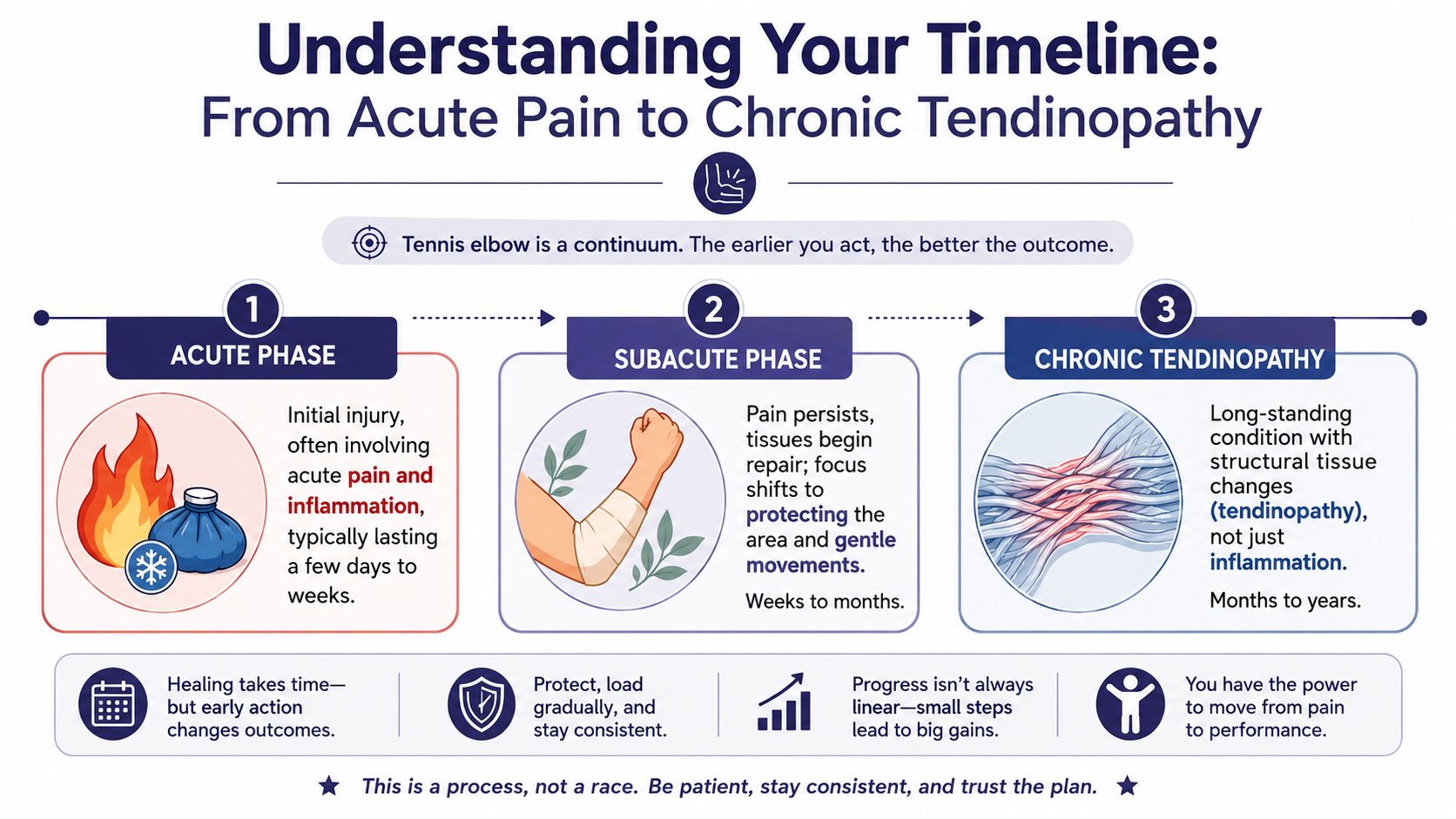
Understanding Your Timeline From Acute to Chronic
Some people call every sore tendon “inflammation”. That's too simplistic. Tennis elbow is usually better understood as a tendinopathy, which means the tendon has been overloaded enough that its structure and function have changed.
Think of it less like a fresh sprain and more like a frayed rope. A frayed rope doesn't improve because you ignore it for weeks and then suddenly hang your full bodyweight on it again. It improves when you reduce the strain that caused the damage, then rebuild its tolerance progressively.
Acute flare versus long-standing problem
A recent flare can settle relatively quickly if you catch it early. That usually means reducing the provoking activity, calming symptoms, and avoiding the instinct to either push through hard pain or stop moving altogether.
A longer-standing case behaves differently. If the elbow has been sore for months, especially if you've kept working through it or tried repeated stop-start rest, the tendon tends to be more irritable and deconditioned. Recovery then becomes less about “waiting for it to go away” and more about restoring load tolerance over time.
That's why someone with a fresh problem may notice daily-life improvement within weeks, while someone with chronic symptoms often needs a much more deliberate rebuild.
Why rest alone often disappoints
Rest has a role, especially early on when every movement is provoking symptoms. But complete rest is rarely enough. Tendons need mechanical stimulus. They don't regain strength from pain avoidance alone.
A better approach is relative rest. Keep the elbow moving within tolerable limits. Remove the worst aggravators. Then introduce loading in a controlled way.
The tendon needs less random strain and more planned strain.
For many patients, this is the turning point. They stop doing painful, repetitive everyday loading and replace it with structured rehab loading.
The chronic stage needs a different mindset
Once tennis elbow becomes persistent, the target changes. You're no longer just trying to settle pain. You're trying to improve tendon capacity so the elbow can cope with your real life again.
That means your timeline should match your demands:
- Desk work: keyboard and mouse tolerance may return earlier than heavy carrying
- Gym training: pressing may be manageable before pulling, gripping, or Olympic-style lifts
- Manual work: repeated twisting, lifting, and tool use often take longer
- Racquet sport: return depends on both pain and the tendon's ability to handle repeated impact and grip
If you want a broader context on tendon biology, this article on how long tendons take to heal is helpful background reading.
Key Factors That Influence Your Recovery Speed
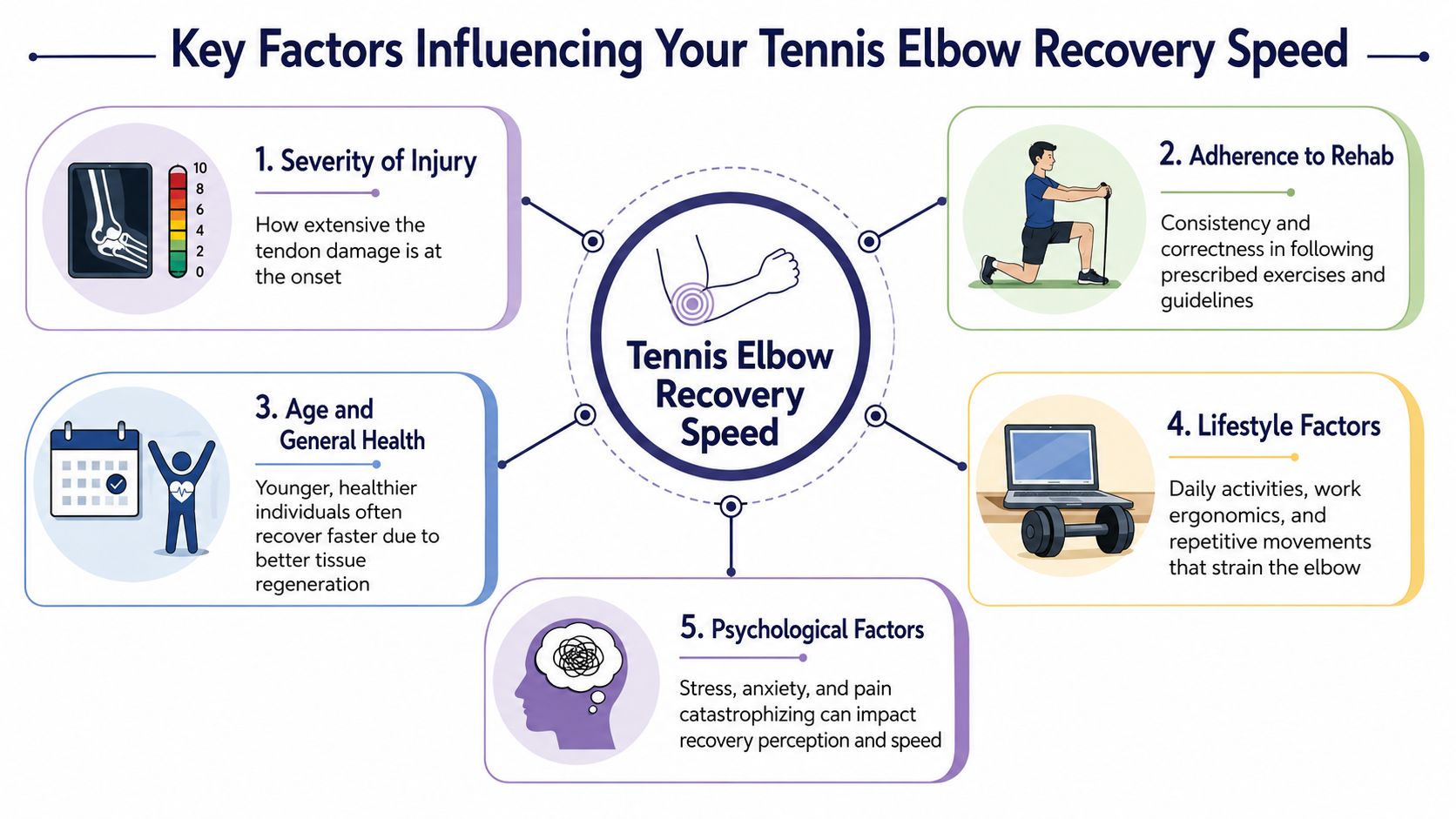
Two people can have the same diagnosis and very different tennis elbow recovery time. That's not because one is “better at healing”. It's usually because their tendon is dealing with different loads, different habits, and different constraints.
Workload often matters more than people expect
The clearest practical divide is what your arm has to do all day. One orthopaedic series reported 3–4 months to full strength and 3–4 months to return to work when the injury was work-related, versus 6–8 weeks when it was not work-related, as outlined in this orthopaedic overview of tennis elbow prognosis.
That fits what clinicians see routinely. If your elbow is exposed to repeated gripping, lifting, twisting, drilling, carrying, or prolonged mouse and keyboard work without adjustment, recovery is slower because the tendon never gets a clean run at rebuilding.
The main variables that change your timeline
Some factors are biological. Others are behavioural. The important point is that several are within your control.
- How long symptoms have been present: A problem that started recently is usually easier to settle than one you've been nursing for months.
- How severe the load mismatch is: If your current work or training still exceeds what the tendon can tolerate, progress stalls.
- How consistent rehab has been: Tendons respond to repeated, sensible loading. They don't respond well to random exercise done only on good days.
- General health and recovery habits: Poor sleep, high stress, and low overall conditioning often make pacing and tissue recovery harder.
- Technique and equipment: In sport, poor racquet mechanics or a sudden jump in volume can keep symptoms alive. At work, poor ergonomics can do the same.
What busy professionals can change quickly
You don't need a perfect lifestyle overhaul to improve your odds. You need to reduce repeated strain and create more recovery space.
Try these first:
- Change how you use a mouse: Alternate hands if possible, lighten your grip, and avoid long unbroken sessions.
- Move your forearm into support: Resting the forearm rather than hovering can reduce sustained tendon demand.
- Break up gripping tasks: Carry smaller loads more often rather than one heavy load in a single trip.
- Modify gym sessions: Use straps selectively, reduce volume, and avoid loading through sharp pain.
- Review recovery habits: A broader evidence-based muscle recovery guide can help you think through sleep, movement, and pacing.
People often blame one workout or one meeting-heavy week. More often, the tendon has been accumulating load from dozens of small repetitions spread across work, commuting, home tasks, and exercise.
The hidden trade-off
The trade-off is simple. Keep your routine unchanged and recovery tends to drag. Modify enough to let the tendon calm down, and you may feel temporarily inconvenienced, but the long-term path is usually shorter.
That's why “just carry on and hope” rarely works well. A tendon can tolerate some discomfort during rehab. It struggles with constant, unplanned irritation.
A Realistic Look at Treatment Timelines
Most tennis elbow improves without surgery, but the timeline depends on what treatment you choose and how consistently you follow through. The key is to match the treatment to the stage of the problem instead of jumping too quickly to the next option.
Tennis Elbow Treatment Timelines at a Glance
| Treatment | Typical Timeline for Effect | Best For |
|---|---|---|
| Relative rest and activity modification | Early symptom settling over days to weeks | Recent flare-ups and people still overloading the tendon daily |
| Physiotherapy and structured loading | Pain should begin improving by week 4–6 if done correctly, with daily exercise often continuing for about 3 months | Most people with ongoing symptoms who need to rebuild tendon capacity |
| Bracing or simple supports | Can help symptom control while active | Short-term support during work or sport modification |
| Injections | Varies by injection type and clinical goal | Selected cases where pain is blocking rehab or diagnosis needs review |
| Surgery | Considered only after prolonged failed conservative treatment | Persistent cases not improving after sustained non-surgical care |
Relative rest works best at the start
If the elbow is newly irritable, don't do nothing and don't do everything. Strip out the movements that clearly aggravate it. That may mean reducing racquet sport, changing lifting style, avoiding repeated palm-down lifting, or adjusting your workstation.
This phase isn't about waiting for a miracle. It's about stopping the repeated mechanical irritation that keeps resetting the problem. Many people feel some relief once they stop provoking the tendon ten times a day.
A brace can sometimes help during this stage, especially if you must work through the problem. But supports are an accessory, not the treatment itself.
Physiotherapy and loading are the cornerstone
The most useful treatment for most patients is a structured loading programme. In UK-style conservative management, pain should begin improving by week 4–6 if the programme is being done correctly, and a commonly used eccentric protocol involves daily exercises for about 3 months, with progression only when 10 repetitions can be completed with minimal pain, according to this review of tennis elbow rehabilitation and eccentric loading.
That timeline matters because people often quit too early. They try exercises for ten days, feel little change, and conclude they've failed. Tendons don't work on that schedule.
What a sensible programme usually includes
A good rehab plan often combines several layers rather than one magic exercise:
- Isometrics: Useful early when pain is high and heavier movement isn't tolerated well.
- Eccentric loading: Commonly used to begin restoring tendon tolerance.
- Progressive strengthening: As pain settles, exercises should move beyond very light rehab into meaningful strength work.
- Functional retraining: Grip, lift, carry, and sport-specific movement need to be reintroduced, not assumed.
If the exercise gives manageable discomfort during the session but you're not worse the next day, that's usually acceptable. If the next day is clearly more painful, the dose was too high.
Injections can help, but they aren't a shortcut
Patients often ask about injections because they want a faster way out. Sometimes an injection has a role. The trade-off is that pain relief can create false confidence. If you feel better quickly but don't rebuild tendon capacity, it's easy to flare again when normal loading returns.
The right question isn't “Will an injection stop the pain?” It's “Will this help me progress rehab safely, or is it masking symptoms for a while?” If you're weighing that up, this guide to tennis elbow injection options helps frame the decision.
Some people also look at broader symptom management strategies, including diet and supplements. If that's relevant to you, this overview of turmeric for inflammation relief may be worth reading alongside your main treatment plan.
Surgery is the last rung on the ladder
Surgery sits at the far end of the pathway, not the start. It's considered only after a long spell of failed conservative treatment. For most patients, the bigger issue isn't lack of available procedures. It's inconsistency with load management and rehab before they ever reach that stage.
If your elbow has been stubborn, that doesn't automatically mean you need an operation. More often, it means the diagnosis needs reviewing, the provoking loads need identifying properly, or the rehab dose needs adjusting.
Your Rehab Roadmap Milestones and Sample Timelines
Recovery gets easier to manage when you stop thinking in one giant block of time and start thinking in phases. You often cope better when you know what the current job is.
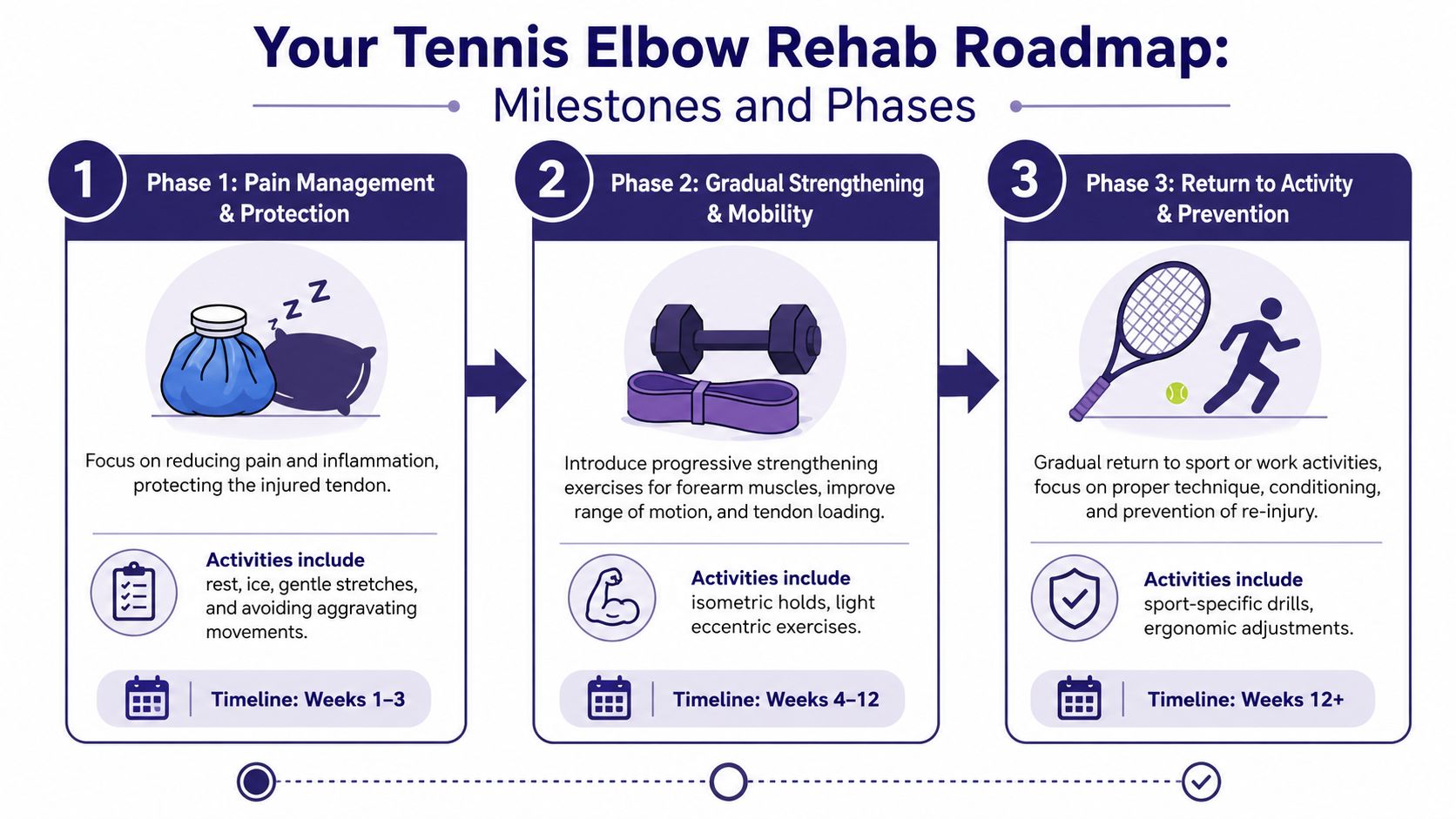
Phase 1 Calm it down
This is the phase where you reduce irritation and regain control. The aim isn't to prove toughness. It's to stop the tendon being poked all day by the same aggravating movements.
That usually means changing a few practical things at once:
- Modify the trigger: Lift with the palm neutral where possible, reduce repetitive gripping, and avoid “testing” the elbow repeatedly.
- Tidy up your workstation: Keyboard height, mouse position, chair support, and forearm support all matter if you work at a desk.
- Use gentle loading: Early isometric work can be a useful bridge when dynamic exercises still feel too provocative.
Typical signs you're ready to move on include reduced day-to-day irritability and fewer sharp pain spikes during ordinary tasks.
Phase 2 Build it up
At this stage, many recoveries either improve properly or stall. Once symptoms are calmer, the tendon needs gradually increasing load. Not random exercise. Not aggressive return to full sport. Structured progression.
A practical sample progression looks like this:
- Start with controlled forearm loading: Light wrist extensor work, often beginning with low resistance.
- Increase only when tolerance is clear: Don't add weight because the calendar says so. Add it because the elbow handled the current level well.
- Rebuild grip strength gradually: Gripping is often the missing piece, especially for gym users, racquet players, and anyone in manual work.
- Track next-day response: The next morning tells you more than the exercise session itself.
Recovery usually feels uneven here. A good week doesn't mean you're done. One flare doesn't mean you're back at the start.
Phase 3 Get back to full function
At this point, the question changes from “Can I do rehab?” to “Can I do my real activities without overloading the tendon again?”
For office workers, that may mean full days of typing, commuting, carrying bags, and gym sessions in the same week. For athletes, it means controlled return to drills, then volume, then intensity. For manual workers, it means repeated tool use, lifting, and sustained gripping without symptom escalation.
A sensible return phase often includes:
- Work-specific drills: carrying, lifting, twisting, tool handling
- Gym-specific drills: rows, deadlifts, pull-ups, farmer's carries, or kettlebells in graded doses
- Sport-specific drills: shadow swings, short hitting sessions, then normal play
- Prevention habits: warm-up, pacing, and technique review
What progress should feel like
The best sign isn't complete absence of sensation. It's improving function with stable or settling symptoms. Many people expect a clean, linear recovery and get discouraged by small flare-ups. Tendon rehab is rarely that neat.
A better benchmark is this. Are you doing more than a few weeks ago with less reaction afterward? If yes, you're usually moving in the right direction.
Prevention and When to See a Private GP
The most useful way to prevent recurrence is to respect the difference between pain settling and tendon recovery. That gap is where many repeat flare-ups start.
The NHS notes that tennis elbow usually gets better after resting the arm for a few weeks, but surgery is only considered after 6 to 12 months, and the tendon itself can take 6 to 12 months to heal even when pain has subsided, as outlined in this NHS guidance on tennis elbow. In practice, that means the elbow may feel improved before it is ready for full gripping, heavy lifting, or a sudden return to sport.
Prevention habits that make a real difference
Generally, prevention is less about gadgets and more about habits.
- Keep strength work in your routine: Don't stop all forearm and grip work the moment pain settles.
- Warm up before demanding tasks: That applies to tennis, golf, gym work, DIY, and long manual sessions.
- Spread load across the week: A sudden spike in workload is a common trigger.
- Check your mechanics: Racquet grip size, lifting style, desk setup, and mouse use all influence tendon load.
- Respect early warning signs: A mild ache after activity is easier to manage than a month of escalating pain.
When self-management has probably run its course
You should stop guessing and get assessed if any of the following apply:
- Your pain isn't improving after 4 to 6 weeks of proper rehab
- You can't do normal work tasks without recurring flare-ups
- Night pain is becoming a feature
- You have numbness, tingling, or symptoms spreading beyond the usual pattern
- The diagnosis isn't clear
- You keep getting temporary relief but no durable progress
At that point, a proper assessment can clarify whether this is straightforward tennis elbow, whether another structure is involved, and whether you need imaging, targeted rehabilitation changes, medication advice, or a different intervention.
If elbow pain is disrupting work, training, sleep, or everyday tasks, The Lagom Clinic offers private GP appointments with time to assess the full picture properly. That includes diagnosis, lifestyle and activity review, treatment planning, and rapid access to onward imaging or specialist care when needed.

 Members Consultation